
Supporting Someone Struggling With Addiction in Ontario
A practical recovery guide for families, students, employers, educators, and communities across Ontario

“Most people don’t think addiction will affect their family — until it does.”
Across Ontario, Canada addiction is affecting families, workplaces, schools, and communities in ways many people never expected.
Not just in large cities.
Not just among teenagers.
And not just among people facing homelessness or poverty.
It affects:
students trying to finish school professionals quietly struggling with alcohol dependency workers managing chronic pain parents overwhelmed by stress and burnout families unsure how to support someone they care about
Many people struggling with addiction continue to –
- go to work every day
- attend school
- maintain relationships
- raise families
- hide what they are experiencing privately
Which means addiction often remains invisible until a crisis happens.
For many people, the hardest part is not realizing something may be wrong.
It’s knowing:
- where to begin
- who to call
- what treatment actually looks like
- whether recovery is realistic
- how to support someone without pushing them away
This guide was created as a calm, practical public resource for:
- families
- students
- employers
- educators
- community organizations
- individuals looking for support
Not as a lecture.
Not as fear-based content.
And not as another generic health article.
But as a practical Ontario-focused resource designed to help people better understand addiction, recovery, treatment options, and support services available across local communities.
Addiction in Ontario: Why Communities Are Paying Attention
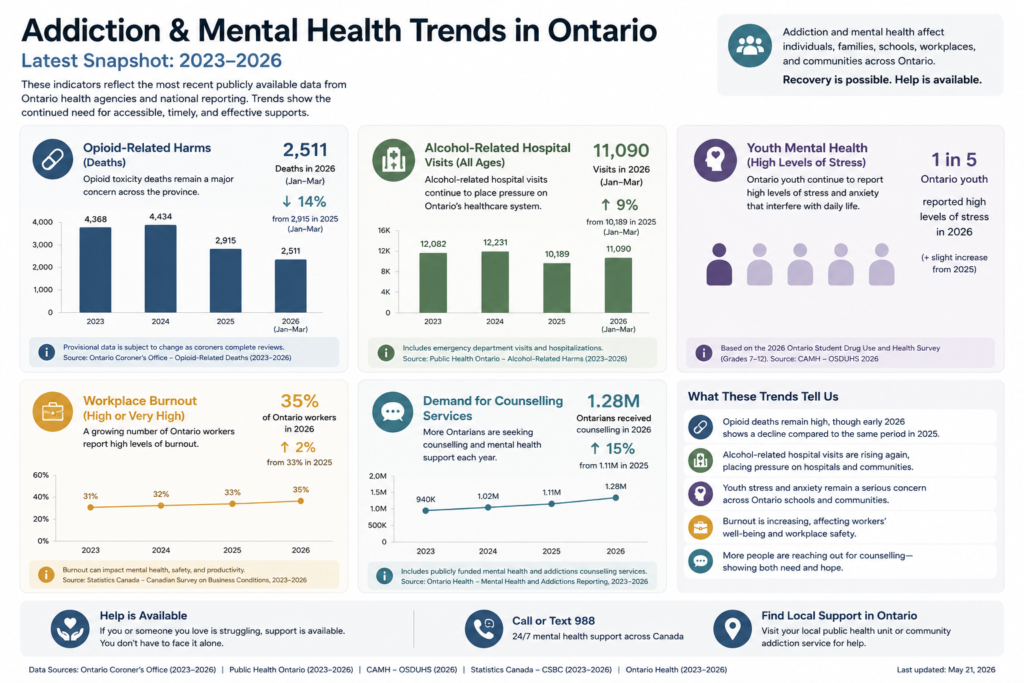
Ontario communities continue facing growing challenges connected to opioid overdoses, fentanyl contamination, alcohol dependency, youth mental health concerns, workplace burnout, and social isolation.
For many families, employers, and educators, these issues no longer feel distant or uncommon.
They are appearing:
- in schools
- in workplaces
- in healthcare settings
- in social circles
- inside ordinary households across Ontario
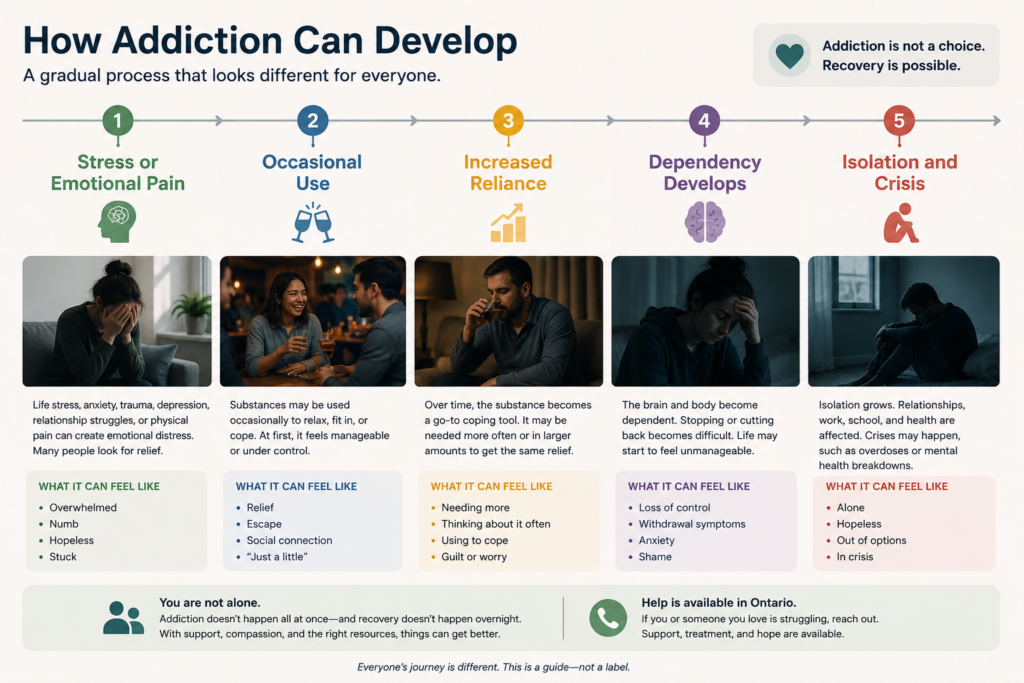
Addiction Often Begins Quietly
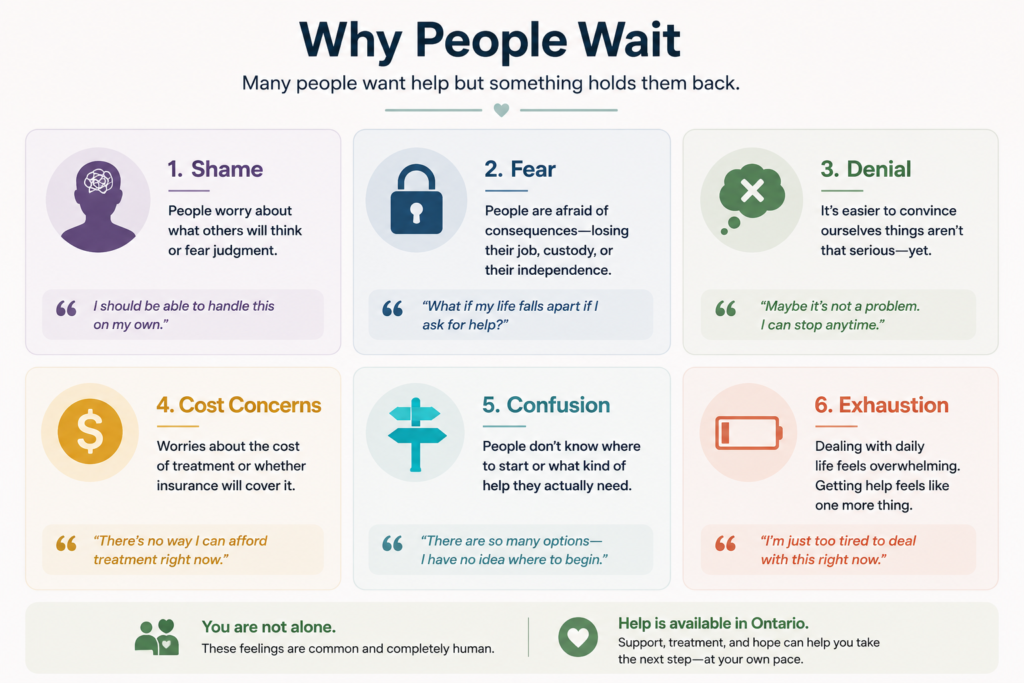
Why Many People Delay Asking for Help
What Should Someone Do First?
One of the most overwhelming parts of addiction is not knowing what step comes next.
When families realize something may be wrong, many panic.
Some try to solve everything immediately.
Others avoid the conversation entirely because they are afraid of making things worse.
In reality, recovery rarely begins with one dramatic moment.
More often, it starts with much smaller steps:
- asking questions
- having one honest conversation
- contacting a support service
- speaking with a doctor or counsellor
- learning what treatment options actually exist
Many people expect recovery to begin with a major intervention or crisis.
But often, it starts quietly.
Sometimes the first step is simply: “I think I need help.”
Or: “I’m worried about someone.”
That moment matters more than many people realize.
For many individuals and families, recovery begins not with certainty — but with the decision to stop facing things alone.
If Someone Is in Immediate Danger
Some addiction-related situations can become medical emergencies very quickly.
Emergency medical support should be sought immediately if someone may be experiencing:
- an overdose
- loss of consciousness
- suicidal thoughts
- severe withdrawal symptoms
- psychosis
- significant medical distress
In emergencies:
- call 911 immediately
- administer naloxone if available
- do not leave the person alone
- seek medical care even if symptoms temporarily improve
In some situations, people hesitate to call for help because they are afraid, overwhelmed, or unsure whether the situation is “serious enough.”
It is always safer to seek emergency medical support if there is uncertainty about someone’s condition.
A fast response can save a life.
If Someone Wants Help but Feels Overwhelmed
Many people do not need to have every answer immediately.
Possible starting points may include:
- speaking with a family doctor
- contacting a counsellor
- exploring community support services
- researching detox or outpatient programs
- attending peer support meetings
- talking honestly with a trusted person
Recovery rarely happens in one perfect decision.
It is usually a process that develops over time.
What Recovery Actually Looks Like
One of the biggest misconceptions about recovery is that everything suddenly changes overnight.
In reality, recovery is often gradual, uneven, and deeply personal.
For some people, recovery begins with small changes that may not seem dramatic at first:
sleeping properly again, attending counselling consistently, rebuilding daily routines, reconnecting with family, or learning healthier ways to cope with stress and emotional pain.
Some people describe recovery as slowly feeling “present” in their own lives again after months or years of emotional exhaustion, dependency, isolation, or instability.
Others describe it as rebuilding trust — both with themselves and with the people around them.
Some days feel hopeful.
Others feel frustrating, exhausting, or emotionally overwhelming.
Many individuals experience setbacks during recovery, especially during periods of stress, anxiety, loneliness, or major life change.
A setback does not automatically mean someone has failed permanently.
For many people, recovery is not about becoming perfect overnight.
It is about gradually creating more stability, healthier coping mechanisms, stronger support systems, and a life that feels manageable again.
For families, one of the hardest things to accept is that recovery is usually not linear.
Progress may happen slowly over months or even years.
But meaningful long-term improvement is absolutely possible.
Understanding Different Types of Treatment
Many people are surprised to learn that addiction treatment is not one single program or one identical experience.
Support options vary depending on:
- severity
- mental health needs
- substance involved
- living situation
- financial circumstances
- personal goals
Some individuals benefit from structured inpatient care.
Others may benefit more from:
- outpatient counselling
- therapy
- peer support
- sober living
- mental health treatment
community-based recovery programs
Detox and Withdrawal Management
Detox programs help individuals safely manage withdrawal symptoms under supervision.
Depending on the substance involved, withdrawal symptoms may range from uncomfortable to medically dangerous.
This is one reason professional medical guidance can be extremely important.
Inpatient Rehabilitation
Residential treatment programs typically provide:
- structure
- counselling
- relapse prevention support
- mental health care
- recovery education
- peer support environments
Programs may vary significantly depending on:
- treatment philosophy
- duration
- specialization
- wait times
- cost
Outpatient Support
Outpatient programs allow individuals to continue daily responsibilities while receiving support.
This may include:
- therapy
- counselling
- relapse prevention planning
- group programs
- mental health support
- addiction education
For some people, outpatient treatment provides flexibility while maintaining work, school, or family responsibilities.
Real-Life Situations Many People Face
At some point, many individuals and families quietly ask themselves difficult questions.
Questions like:
“Is this becoming a serious problem?”
“How do I help someone without pushing them away?”
“What if they refuse support?”
“What if I’m the one struggling?”
These situations are far more common than many people realize.
In many cases, addiction develops gradually enough that people spend months — or even years — trying to minimize what they are experiencing, hoping the situation will improve on its own.
“I Think My Son or Daughter May Have a Problem”
For many parents, one of the hardest parts is uncertainty.
Some struggle with denial.
Others feel guilt, fear, frustration, or conflict inside the home.
Many worry that bringing up addiction could damage their relationship with their child or push them further away.
In reality, calm and compassionate conversations are usually far more effective than anger, panic, or confrontation.
In many situations, the goal is not to “win” one conversation.
It is to create an environment where honest communication and support become possible over time.
“I’m Drinking More Every Night”
Alcohol dependency often develops gradually, which is one reason many people do not recognize the warning signs immediately.
What begins as a way to manage stress, loneliness, burnout, anxiety, or emotional exhaustion can slowly become a daily coping mechanism that feels difficult to stop.
Many individuals continue functioning professionally while privately struggling for years.
From the outside, their lives may appear stable.
Privately, they may feel overwhelmed, emotionally exhausted, isolated, or increasingly dependent on alcohol to relax or cope.
“I’m Worried About an Employee”
Many people experiencing addiction continue showing up to work every day while privately managing stress, dependency, anxiety, emotional exhaustion, or burnout.
In some workplaces, fear of judgment or professional consequences prevents employees from seeking support early.
Supportive workplace environments can sometimes encourage earlier intervention, reduce stigma, and help individuals feel safer discussing mental health or addiction-related concerns before a crisis develops.
Explore Support Resources Across Ontario
Toronto
Counselling services, detox resources, sober living support, and recovery information available across Toronto communities.
Explore support resources in Toronto
Mississauga
Community wellness programs, treatment information, and addiction support services in Mississauga.
View Mississauga recovery resources
Hamilton
Mental health services, counselling support, and addiction recovery resources available in Hamilton.
Explore Hamilton support programs
Ottawa
Treatment information, community support services, and wellness resources across Ottawa.
View Ottawa recovery resources
London
Recovery programs, counselling services, and community wellness support available in London.
About the Author
Addiction Help Canada Editorial Team is an Ontario-focused resource team dedicated to creating practical educational content related to addiction recovery, mental health support, counselling resources, and community wellness services across Canada.
Our goal is to help individuals, families, students, and employers better understand:
- addiction recovery options
- mental health support services
- counselling resources
- treatment pathways
- community-based support programs
Content published on Addiction Help Canada is intended for informational and educational purposes only and should not replace professional medical advice, diagnosis, or treatment.
Medical Disclaimer
The information on Addiction Help Canada is provided for educational and informational purposes only and is not intended as medical advice.
Individuals experiencing a medical emergency, overdose, severe withdrawal symptoms, or mental health crisis should contact emergency services or seek immediate professional care.
Always consult qualified healthcare professionals regarding medical or mental health concerns.